
Same-day when the schedule allows
Commercial Pest Emergency in Columbus, OH
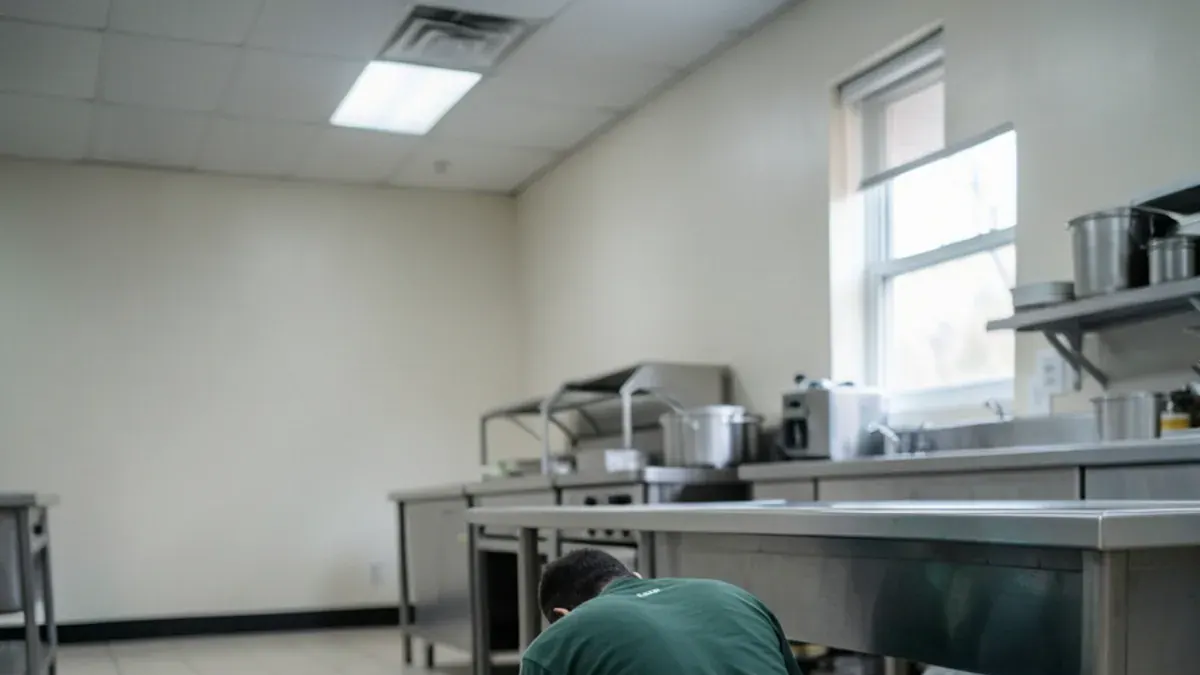
A commercial pest emergency in Columbus, OH is a pest problem that threatens your guests, your inspection or your reputation today: a customer sighting in the dining room, a bed bug report from a hotel guest, a violation on a health inspection. Boydes Exterminating Co responds as quickly as the schedule allows, as part of our wider emergency pest control in Columbus service.
- Serving Columbus since 1990
- 4.5★ from 55 Google reviews
- Owner-run, based on Dunning Rd
- One-time or recurring service
We do not name a response time that the day may not hold. We do tell you honestly what is possible, what to do while you wait and what paperwork you will have afterward.
What counts as a commercial pest emergency?
It is urgent when the pest is somewhere it should never be and someone with authority or money is watching. For food businesses and hotels, that happens quickly.
- A customer or staff member sees a roach, rodent or fly in a dining room, prep area or bar
- A health inspection notes pest activity and sets a date for re-inspection
- A hotel guest reports bed bugs, or housekeeping finds signs in a room
- Droppings or gnawing turn up in dry storage, a walk-in or a loading area
- Residents in an apartment building report roaches, bed bugs or rodents in several units at once
Apartment managers carry a specific duty. Columbus Public Health says the Columbus Health Code makes the owner of a dwelling with two or more units responsible for eliminating pests. A building with multiple complaints needs a plan, not a single-unit visit.
A customer saw a pest in your restaurant. What do you do first?
Handle the guest first, and handle the evidence second. A calm, specific response protects your reputation more than a quick denial. Then do these things while you wait for us:
- Write down the time, the place in the building and exactly what was seen
- Photograph the pest or the evidence, and capture a specimen in a sealed bag or under clear tape if you can do it without touching food
- Do not spray anything in a food area. Store-bought products can contaminate surfaces and scatter the pest
- Follow your own food safety procedures and your health department's guidance for any food or surfaces involved
- Tell us what you found and where, so the technician starts at the right spot
Our post on your first 24 hours after a restaurant pest sighting walks through the response in more detail.
Guest reported a bug?
Call as soon as we open and tell us what was seen and where. A clear description gets the technician started in the right spot.
- Serving Columbus since 1990
- 4.5★ from 55 Google reviews
- Owner-run, based on Dunning Rd
- One-time or recurring service
Prefer to write it down?
Calling is fastest. The form comes to the same desk, and we call you back during business hours.
Call (209) 563-1650How fast can you reach a Columbus business?
As fast as the schedule allows, which means it varies. A same-day visit is possible when a slot is open and the drive fits the route. Tell us it is urgent and we weigh that when we set the day. We will not name an arrival time before we have looked at the schedule.
Two practical points. First, we work Monday to Thursday 8 am to 7 pm, Friday 8 am to 6 pm and Saturday 10 am to 5 pm, and we are closed Sunday. A problem found during a Saturday dinner service waits until we open, so call at opening on Monday if that happens. Second, the sooner in the day you call, the more room the schedule has. A call at 9 am has more options than one at 4 pm.
The Dunning Rd shop is about 7 minutes from central Columbus and 11 from Whitehall and Gahanna, so downtown restaurants and east side hotels are close. If today cannot work, we say so on the call and offer the next opening.
Failed health inspection and pests: how we help before the re-inspection
A pest violation on an inspection report comes with a deadline. Read the report, note exactly what the inspector wrote, and call us with a copy. The health department that licenses your operation, such as Columbus Public Health inside the city, decides what it needs to see. We cannot promise how a re-inspection turns out.
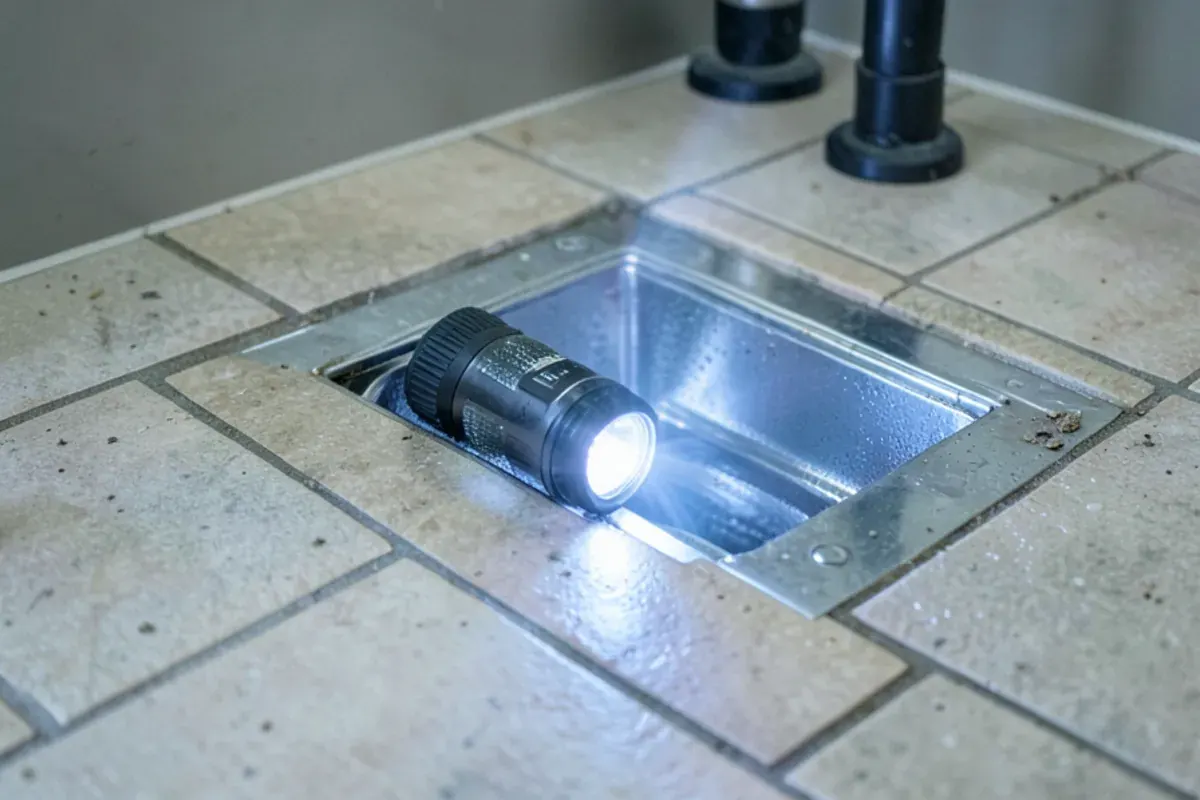
What we can do is find the source, treat the problem, point out the conditions that feed it and give you documentation after the inspection. For roaches, that means checking the places that inspectors check and that staff overlook: under equipment, behind coves, inside door frames and around drains. For rodents, it means finding the entry points and the harborage, not just placing traps.
Some of the fix is yours. Fixing a leaking pipe, tightening a door sweep or changing how waste is stored matters as much as treatment. We tell you what we see so you can act before the inspector returns.
Hotel bed bug emergency: what to do tonight
A single guest report is enough to treat the room as active. Take the room out of service. Do not move bedding, luggage or furniture to another room, since that spreads the problem. Bag linens where they are, and leave the mattress and headboard alone.
The rooms on either side, above and below get checked as well. Bed bugs travel through shared walls and plumbing runs, so one room is often a hint of more. After inspection we recommend a method that fits the property. Options include heat treatment, a barrier treatment and a residual course, and the choice depends on the rooms involved and how fast you need them back in service. We explain the trade-offs in plain terms.
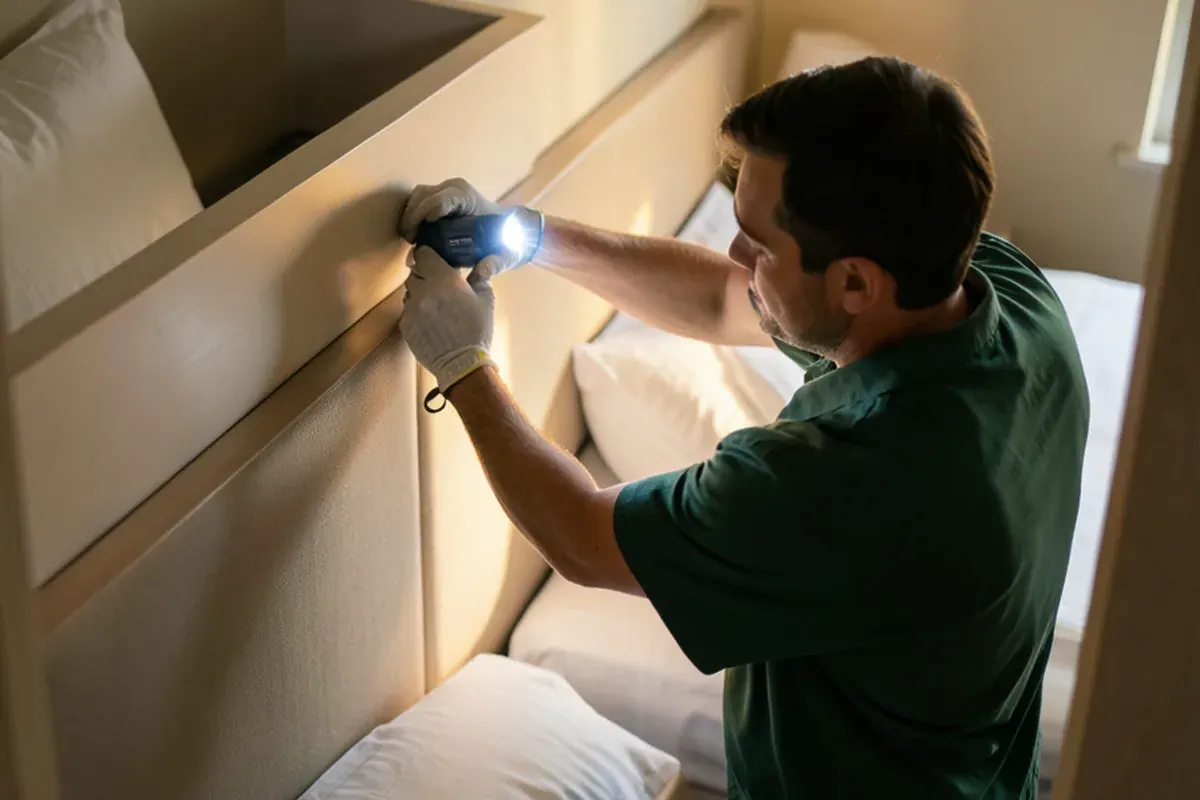
For guest communication, keep records of when the report came in, what was found and what you did. Documentation helps if a guest or an insurer asks later.
What should a business pest incident log include?
A clear record helps inspectors, insurers and your own managers. Start it the moment the sighting is reported and keep it in one place.
- Date, time and the exact room or area where the pest or evidence was seen
- Who saw it, and what they reported, in their own words
- Photos of the pest, droppings, bite marks or damage, with a coin or ruler for scale
- What staff did right away, such as isolating food, closing a room or cleaning a surface
- The date and time you called us, the visit date and our service documentation
- Corrections you made, such as repairs, door sweeps, drain cleaning or waste changes
Bring the log to the walk-through. Technicians start at the spot where the pest was seen, and a precise record shortens that part of the visit. It also answers the first question any inspector asks, which is what you did and when.
A log is not a substitute for a treatment plan. It shows what happened, and the plan shows what changes. After an incident, many managers ask for follow-up visits so the next entry in the log reads quiet.
What happens when we arrive at your business?
- We start with a walk-throughYou show us where the sighting or complaint happened. We note the layout, equipment and how staff move through the space.
- We ask about food, guests and allergiesOpen food, people with allergies and sensitive areas change what gets applied and where. We ask at each visit.
- We inspect, then explain the priceWe inspect the affected area and the spaces around it. You hear the price before work starts, based on the type and extent of the problem.
- We treat per label directionsProducts go on as the label directs. You get the re-entry time and what to wipe down before service resumes.
- You get documentation and a planWe provide documentation after an inspection and set the follow-up visits: biweekly, monthly, bimonthly or as needed.
What does a commercial pest emergency cost?
The type of pest and the extent of the problem set the price, and we explain it before work starts. A single sighting with no harborage is a small job. A kitchen with German roaches behind every piece of equipment, a hotel floor with several rooms of bed bugs or a building with rodents in the walls is a larger one.
The factors are the pest, the number of rooms or units, the size of the space, how hard it is to reach and how many follow-up visits the plan needs. Past customers say our pricing was fair, with no surprise charges. If you want to know whether a same-day visit changes the cost, ask on the call.
Ohio requires any company applying pesticides for hire to hold an ODA Pesticide Business License, and ODA's online search lets you check a company before you hire.
Pest violations at Columbus businesses: who inspects, and what to check on a treatment company
Your local health department licenses and inspects a food business, and inside the city that is Columbus Public Health. The inspection report names the violation and the re-inspection date. Keep the original, and ask the inspector in writing which items must be corrected and by when. In an apartment building, the Columbus Health Code makes the owner responsible for eliminating pests.
Treatment falls under a separate rule. For any pesticide application done for hire, Ohio expects an ODA Pesticide Business License on the company, and you can confirm it in ODA's public lookup. Before anyone treats a kitchen, ask for the product names, where each will go and the label's re-entry time, since food areas carry stricter label limits than a hallway.
Why Boydes Exterminating for this work
Our customers include hundreds of homeowners, hotels and restaurants in central Ohio, plus apartment managers.
You get paperwork you can keep with your records, which helps with inspectors and insurers.
Follow-up visits can be biweekly, monthly, bimonthly or as needed, for residential and commercial accounts.
The company was founded in 1990 by Mr. Robert Boyde, and Robert J. Boyde Jr. runs it from 1967 Dunning Rd, so decisions get made by the person you talk to.
Google reviewers put us at 4.5 stars. You can pay by cash, check, debit or credit card, which suits businesses paying from a company account.
Where we do this work
- Columbus About 56% of Columbus homes are rented, and the city's dense restaurant and hotel blocks sit minutes from Dunning Rd.
- Whitehall About 61% of Whitehall homes are rented, so apartment managers along East Broad and East Main need quick answers.
- Grandview Heights Grandview Yard apartments have been going up since 2012, and 43% of homes in the city are rented.
- Dublin Bridge Park mixes apartments, offices and restaurants on the Scioto River, so kitchens there answer to inspectors.
- Westerville Otterbein University and the Uptown district put student housing and food businesses close together.
- Reynoldsburg About 39% of homes are rented, and a city split across three counties means more than one health department.
- Gahanna About 11 minutes from the shop, with 31% of homes rented and Big Walnut Creek running through the city.
- Bexley Capital University brings student moves and housing into a city about 9 minutes from Dunning Rd.
- Obetz Warehouse and distribution employers around the Rickenbacker logistics zone mean loading docks and dumpsters that rodents use.
Our commercial calls cover Columbus and nearby suburbs, including Whitehall, Gahanna, Reynoldsburg and Westerville. See the full list of service areas.
Commercial Pest Emergency: common questions
A customer saw a pest. What do I do first?
Record the time, location and what was seen, then photograph the pest or evidence. Do not spray anything in a food area. Follow your food safety procedures for affected food and surfaces, then call us with the details. Where the sighting happened tells the technician where to start looking.
How fast can you reach a Columbus business?
It depends on the schedule. Same-day visits are possible when a slot is open and the route fits. Tell us it is urgent and we weigh that. We do not promise a time we cannot meet. Calling early in the day leaves the most room, and we will offer the next opening if today is full.
Can you help after a failed inspection?
Yes. Send us the report and tell us the re-inspection date. We inspect, treat, point out the conditions feeding the problem and give you documentation. The health department decides what it needs to see, and we cannot promise how the re-inspection turns out. Some fixes, like repairs or waste handling, are yours.
Can you work around my business hours?
Within our own hours, yes. We work Monday to Thursday 8 am to 7 pm, Friday 8 am to 6 pm and Saturday 10 am to 5 pm, and we are closed Sunday. Tell us when your kitchen is busy and when it is quiet, and we will plan the visit around the slow stretch.
What records do I get?
We provide documentation after an inspection, and you can keep it with your pest control logbook and show it to an inspector or insurer. Tell us what your health department or franchise asks for. We cannot promise it will satisfy every requirement, but we will write up what we found and what we did.
Can the emergency visit turn into regular service?
Yes. Many businesses move from an urgent call to a schedule once the problem is under control. Follow-up visits can be biweekly, monthly, bimonthly or as needed, and we set the schedule based on the pest and the building. You decide whether to continue after seeing the first plan.
Sources
- Columbus Public Health, Columbus Health Code (owner responsibility for pests in dwellings with two or more units)
- Ohio Department of Agriculture, Pesticide Business License search
What customers say
4.5 stars from 55 Google reviews, checked November 2026. Read more reviews · Leave a review
Rob is a great find. Today was the second time he came out because I found two more yellow jacket nests. One in the ground and one at the foundation of the house. He came out the same day I called.
Great service. Super dependable. Calls right back. This time he was able to come out same day.
I manage a few rental properties around the city and Mr Boyde is the only exterminator that I can rely on to be on. Only had to make 1 visit and the problem was resolved.
Get your business back on track
Tell us what happened, what the inspector wrote or what the guest reported. We will tell you what is possible and when.
- Serving Columbus since 1990
- 4.5★ from 55 Google reviews
- Owner-run, based on Dunning Rd
- One-time or recurring service
Boydes Exterminating Co, 1967 Dunning Rd, Columbus, OH 43219